




 Arun Kumar
 Last Updated on July 7, 2026 by Arun Kumar
TL;DR: High-performing YouTube titles bridge the gap between search algorithms and human psychology. By implementing YouTube title best practices, creators can significantly increase their click-through rate (CTR) and search visibility. This guide covers character limits, keyword placement, and curiosity gaps to ensure your videos get noticed. Mastering how to title a YouTube video involves aligning your text with your thumbnail to create a cohesive story.
A single line of text can be the difference between a viral breakout and a total flop. According to data from various creator studies, videos with optimized titles see up to a 500% increase in reach compared to those that rely on “vibe-based” naming. While most creators obsess over expensive cameras or lighting, the real battle for attention is won in the split second a viewer scrolls past your upload.
What separates watched videos from ignored ones is more than just a flashy thumbnail. Your title is the primary signal to YouTube’s recommendation engine about who should see your content. It sets a psychological “contract” with the viewer; if you break that contract, your channel dies. If you fulfill it, you build an empire.
This guide delivers a proven, data-backed system for crafting titles that dominate both the search bar and the “Suggested” sidebar. You will walk away with specific formulas, SEO strategies, and a workflow used by top-tier channels to guarantee clicks.
Why Your YouTube Title Is the Most Underrated Growth Lever
Your title is not just a label; it is a packaging tool that serves two masters: the YouTube algorithm and the human brain. While the thumbnail grabs the eye, the title seals the deal by confirming the value proposition.
How YouTube actually uses your title as a ranking signal
The algorithm uses your title to categorize your video within its massive database. When you use YouTube title best practices, you provide keyword signals that help the AI understand your topic. This isn’t just about the words you type; the system cross-references your title with your video transcription and tags to ensure relevancy. If your title says “How to Bake Bread” but you never say those words in the video, your ranking will suffer.
The CTR–retention loop: what happens after the click
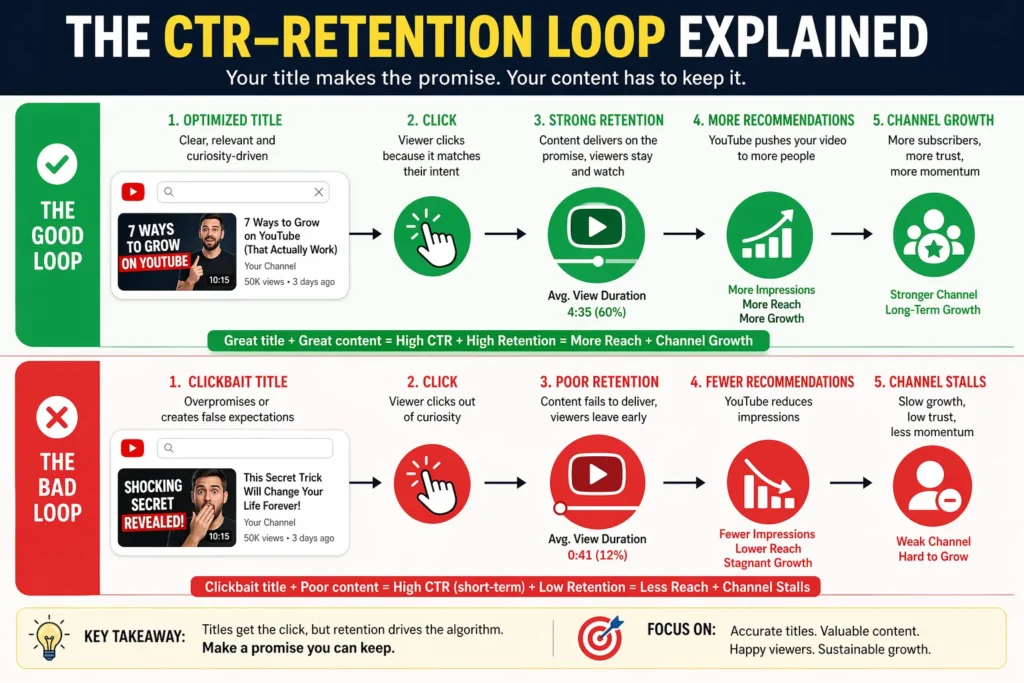
Clicks are only half the battle. There is a “CTR–retention loop” that dictates your long-term success. If your title creates a massive “curiosity gap” but the video fails to deliver the answer in the first 30 seconds, viewers will bounce. This “promise calibration” is essential. YouTube tracks “Satisfied CTR”—clicks that lead to meaningful watch time. If you overpromise, the algorithm will eventually stop showing your video because it views your content as low-quality or deceptive.
ALSO SEE: How to Start a YouTube Channel in India in 2026
Titles vs thumbnails: which one matters more?
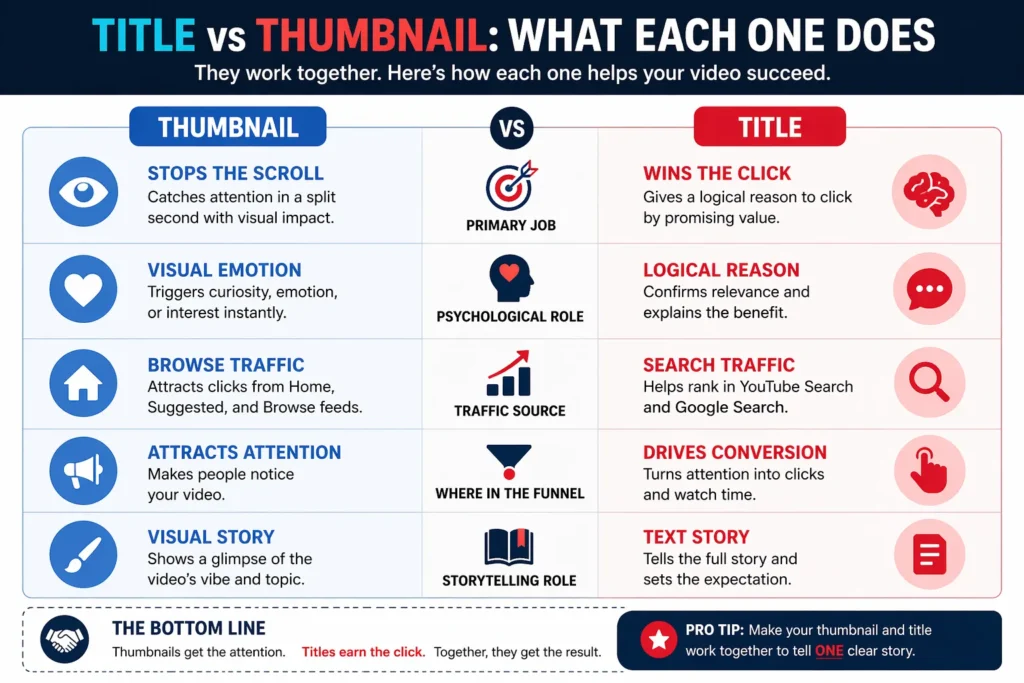
They are a symbiotic pair. The thumbnail creates an emotional reaction, while the title provides the logical justification for the click. However, titles do the heavy lifting for SEO. A thumbnail cannot help you rank in Google Search or YouTube Search for “best budget cameras,” but a keyword-optimized title can. In the early stages of a channel, the title is often the more powerful lever for discovery.
The Anatomy of a High-Performing YouTube Title
To master how to title YouTube videos, you must understand the underlying structure that triggers both search bots and human curiosity.
What makes a good YouTube title?
A good YouTube title is a concise, high-clarity headline that combines a primary search keyword with a compelling emotional hook or “payoff” promise. It must be under 60 characters to avoid truncation, accurately represent the video content to maintain viewer trust, and create a specific reason for the user to click over competing videos in the same feed.
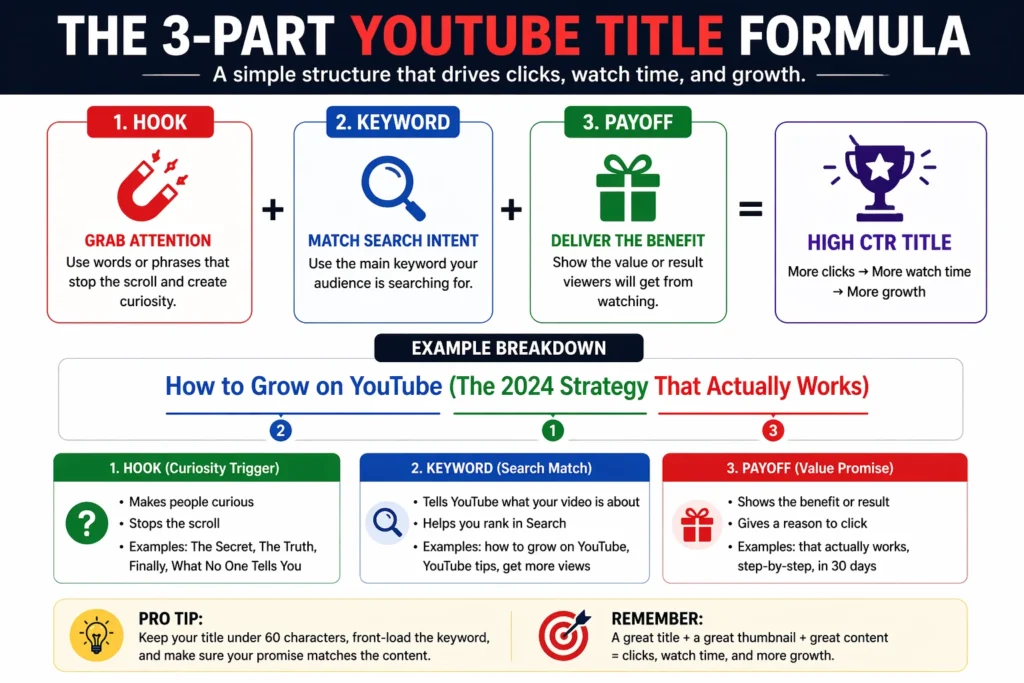
The 3-part structure — hook + keyword + payoff
Every elite title generally consists of three distinct elements:
- The Hook: A word or phrase that stops the scroll (e.g., “The Secret,” “Stop Doing This,” “Finally”).
- The Keyword: The core topic people are searching for (e.g., “YouTube title best practices”).
- The Payoff: The benefit the viewer receives (e.g., “…to Get 10x Views”).
Annotated example breakdown
- Example 1: “How to Grow on YouTube (The 2024 Strategy That Actually Works)”
- How to Grow on YouTube = Keyword/Topic.
- The 2024 Strategy = Freshness/Authority.
- That Actually Works = The Payoff (solving the pain point of failed strategies).
- Example 2: “5 Morning Habits That Saved My Life”
- 5 Morning Habits = List/Structure.
- Saved My Life = Extreme emotional hook.
YouTube Title Best Practices: 12 Rules That Actually Work
Implementing these rules will transform your youtube video title ideas from guesses into strategic assets.
1. Keep it under 60 characters — but know the real reason why
Your title must be readable across all devices without being cut off.
The 60-character limit isn’t an arbitrary YouTube rule; it’s a UI constraint. Once you exceed 60 characters, YouTube often adds an ellipsis (…) on mobile devices, which is where over 70% of views happen. If your “payoff” is at the end of a 90-character title, the viewer will never see it.
- Weak: My Journey of Learning How to Code in Python in Only Thirty Days During My Summer Vacation
- Strong: I Learned Python in 30 Days (Here is How)
2. Front-load your keyword in the first 4–5 words
Place your most important information at the beginning of the title.
Both humans and algorithms scan from left to right. By placing your primary keyword early, you immediately signal relevancy. This is one of the most vital youtube video title tips for search-based channels.
- Weak: Why you should really consider using YouTube title best practices for your channel
- Strong: YouTube Title Best Practices: The Secret to More Views
3. Use numbers — and know when NOT to
Numbers provide a mental “container” for the information you’re sharing.
Psychologically, numbers (like “5 Tips” or “$1,200”) provide a sense of order and predictability. Use odd numbers for lists as they often test higher for authenticity. Avoid numbers when telling a deeply personal or cinematic story, as it can make the video feel like a “listicle.”
- Weak: Some ways to save money this year
- Strong: 7 Simple Ways to Save $500 This Month
4. Add brackets or parentheses for context and format cues
Use extra punctuation to highlight the “extra” value of a video.
Brackets act as a visual “pop” that separates the topic from the meta-information. This helps clarify the video’s value proposition without cluttering the main phrase.
- Weak: How to edit videos like a pro tutorial for beginners
- Strong: How to Edit Videos Like a Pro [Full Masterclass]
5. Use power words that signal value, not hype
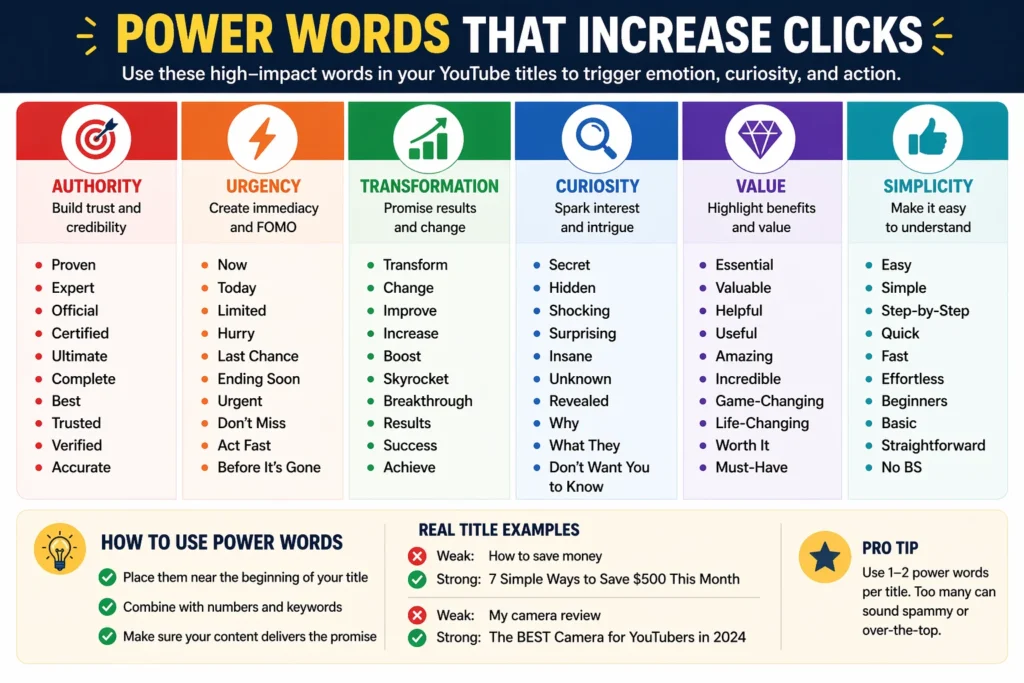
Power words trigger an emotional response or curiosity without being “clickbaity.”
Power words should offer specificity. Instead of “amazing,” use “proven.” Instead of “good,” use “essential.”
| Power Word Category | Examples |
| Authority | Proven, Certified, Official, Expert |
| Urgency | Now, Today, Fast, Limited |
| Simplicity | Easy, Step-by-Step, Simple, Checklist |
| Transformation | Before/After, Growth, Results, Saved |
6. Match your title promise to your video’s actual delivery
Ensure the content of the video fulfills the expectations set by the title.
If you title a video “How to Get 1,000 Subscribers” but only talk about your day, viewers will leave. This ruins your “Average View Duration,” which signals to YouTube that your video is low quality.
- Weak: I won the lottery (Actually just found $5)
- Strong: I Found $5 and Spent It on 5 Mystery Boxes
7. Align title and thumbnail so they tell one story
The title and thumbnail should complement, not repeat, each other.
If your thumbnail has the text “It Failed,” your title shouldn’t also be “It Failed.” The title should provide the context the thumbnail lacks. Read more on how to design a YouTube thumbnail
- Weak: Title: How to fix a car. Thumbnail text: How to fix a car.
- Strong: Title: 3 Tools That Make Car Repair Easy. Thumbnail text: Never Go to a Mechanic.
8. Write for your audience’s exact language, not yours
Use the terms your target viewers actually type into the search bar.
Avoid industry jargon unless your audience is exclusively experts. If you are a fitness coach, your audience might search for “get rid of belly fat” rather than “adipose tissue reduction.”
- Weak: Methods for Mitigating Thermal Throttling in Laptops
- Strong: Stop Your Laptop From Overheating (3 Easy Fixes)
9. Use the current year only when content is genuinely time-sensitive
Only add [2024] or [2025] if the information changes annually.
Adding the year signals “freshness” for topics like software tutorials, tax laws, or tech reviews. Don’t add it to “How to Boil an Egg,” as that process hasn’t changed in centuries.
- Weak: How to Draw a Dog (2024)
- Strong: Best Graphic Design Software [2024 Update]
10. Avoid clickbait — here’s exactly where the line is
Create curiosity without being dishonest.
Clickbait is a “broken promise.” A “curiosity gap” is a “delayed promise.” It’s okay to withhold information (e.g., “The One Tool I Can’t Live Without”), provided that tool is actually revealed and valuable in the video.
- Weak: You won’t believe what happened (Nothing happened)
- Strong: This $10 Gadget Changed My Entire Workflow
11. Draft 3 versions before publishing — then pick the strongest
Never go with your first instinct; it’s usually the most boring one.
The first title is usually a functional description. The second is usually an over-the-top hook. The third is usually the perfect middle ground.
- Draft 1: My review of the iPhone 15.
- Draft 2: The iPhone 15 is the worst phone ever.
- Draft 3: Why I’m Returning My iPhone 15 (Honest Review).
12. Audit and refresh titles when CTR drops
Update your titles for older videos to give them a second life.
Most creators “set and forget” their videos. If a video has high impressions but a CTR below 2%, your title has “decayed” or isn’t resonating. Changing the title can re-trigger the algorithm to test the video with a new audience.
- Action: Go to YouTube Studio, find a video from 6 months ago with low CTR, and apply the 3-part structure (Hook + Keyword + Payoff).
[KEY TAKEAWAY]
YouTube title best practices are about balancing SEO for the algorithm and psychology for the viewer. Keep titles under 60 characters, front-load keywords, and always ensure your video content delivers on the “promise” your title makes to prevent audience drop-off.
YouTube Title Formulas by Content Type (Copy-Paste Templates)
Stop staring at a blank screen. Use these proven frameworks to build your next title.
Tutorial and how-to titles
How to [Achieve Result] in [Timeframe] (Even if You Are a Beginner)The Simple Way to [Task] Without [Common Pain Point][Task] Like a Pro: 5 Steps to [Result]
List and ranking titles
5 [Items] I Wish I Knew About SoonerThe Top 10 [Category] for [Current Year] (Ranked)3 Reasons Your [Project] is Failing (And How to Fix It)
Story and transformation titles
I Tried [Activity] for 30 Days and [Surprising Result] HappenedFrom [Point A] to [Point B]: How I [Achieved Goal]Why I Quit [Common Habit] After [Number] Years
Challenge and controversy titles
Is [Popular Product/Person] Actually Worth the Hype?I Followed [Celebrity]’s Routine for a Week and It Was [Adjective]Stop [Common Action] if You Want to [Achieve Goal]
Niche-specific formulas
- Finance:
How to Invest $[Amount] in [Current Year] (Step-by-Step) - Cooking:
The Only [Dish] Recipe You’ll Ever Need - Tech:
[Product A] vs [Product B]: Don't Buy Until You Watch This - Education:
The [Topic] Concept Explained in 5 Minutes - Fitness:
How to [Muscle Group] at Home (No Equipment Needed)
[KEY TAKEAWAY] Formulas aren’t “lazy”—they are structures that respect human psychology. Use them as a baseline and then customize the “Power Words” to fit your unique channel voice and niche.
How to Title YouTube Videos Based on Your Channel Stage
Your strategy must evolve as your authority grows. What works for MrBeast will not work for a channel with 10 subscribers.
0–1K subscribers — SEO-first titles for discoverability
When you have no audience, the algorithm has no data on who to show your video to. You must rely on search. Your titles should be literal and keyword-heavy so you appear when people search for specific problems. Focus on how to get your first 1,000 subscribers by answering specific questions.
- Strategy: “How to [Long-tail Keyword]”
- Example: “How to set up a Sony A6400 for beginners”
1K–50K subscribers — blend SEO with curiosity hooks
Now that you have a small “seed” audience, YouTube will push your videos to their Home screens. You can start being more creative. You still need keywords for search, but you need an emotional hook to compete for clicks in the Suggested feed.
- Strategy: “[Keyword]: Why This is a Game-Changer”
- Example: “Sony A6400 Setup: Why your footage looks bad”
50K+ subscribers — lead with personality and brand
At this stage, your subscribers click because they like you. You can use “Curiosity-first” titles where the keyword is less important than the story.
- Strategy: “I can’t believe I did this…”
- Example: “I’m finally selling my camera.”
| Channel Stage | Primary Focus | Title Style |
| New (0-1k) | Search Discovery | Literal, Keyword-heavy |
| Growing (1k-50k) | Browse & Search | Hybrid (Keyword + Hook) |
| Authority (50k+) | Community / Browse | Story-driven, Personal |
[KEY TAKEAWAY]
Don’t mimic giant creators’ “vague” titles if you’re a small channel. Use search-focused titles to build a foundation, then transition to curiosity-based titles as your loyal community grows.
How to Do YouTube Keyword Research for Titles (Step-by-Step)
Don’t guess what people want. Use data to find out what they are already looking for. Use this complete YouTube SEO guide] workflow to find winning keywords.
Step 1 — Use YouTube Autocomplete to find real search phrases
Open an Incognito window and go to YouTube. Type your main topic into the search bar but don’t hit enter. The suggestions that drop down are the exact phrases people are typing right now. These are your goldmine for youtube video title ideas.
Step 2 — Validate with Google Trends (YouTube filter)
Go to Google Trends and switch the filter from “Web Search” to “YouTube Search.” Compare 2–3 variations of your title idea. For example, compare “How to Bake Bread” vs. “Homemade Bread Recipe.” Pick the one with the higher, more consistent trend line.
Step 3 — Analyze competitor titles for keyword patterns
Look at the top 3 videos for your target keyword. Are they using numbers? Are they using brackets? Don’t copy them, but identify the “content gap.” If all three are “How to…”, maybe yours should be “The Best Way to…” to stand out.
Step 4 — Choose between search-intent keywords vs curiosity-hook keywords
Decide if this video is for “Search” (evergreen, helpful) or “Browse” (viral, emotional). If it’s for search, keep the keyword at the very beginning. If it’s for browse, put the emotional hook first.
How to Title YouTube Videos for Mobile and Every Surface
YouTube is viewed on everything from 5-inch phones to 80-inch TVs. Your title must work everywhere.
How titles truncate across different surfaces
- Search results: You get about 60 characters.
- Suggested feed: You get about 55 characters before the text cuts off.
- Mobile Home feed: This is the tightest. You often only see the first 42–48 characters.
- YouTube Shorts shelf: These titles are very short, often only showing 40 characters.
The “safe zone” — what viewers always see regardless of device
The first 40 characters are your most valuable real estate. If you don’t communicate the value of the video in those first 40 characters, you are losing views on mobile. This is the “safe zone.” Put your hook or your most important keyword here.
How to A/B Test and Improve Your YouTube Titles
You don’t have to get it right the first time. Professional creators use data to “pivot” their titles until they find a winner. Check your YouTube Studio analytics for deeper metrics.
YouTube Studio’s built-in title testing feature
YouTube now offers a “Test & Compare” feature for many channels. You can upload up to 3 different titles, and YouTube will rotate them among viewers to see which one generates the highest watch time.
What metrics to watch (and for how long)
- CTR: Aim for 4–8%. If you’re below 2%, your title/thumbnail combo is failing.
- Average View Duration (AVD): If your CTR is 15% but your AVD is 10%, your title is clickbait and is hurting your channel.
- Timeline: Wait at least 14 days before changing a title. The algorithm needs time to find the right audience.
When to update an old title vs leave it alone
If a video is “flatlining” (getting zero views), you have nothing to lose by changing the title. However, if a video is already ranking #1 for a search term, do not touch it. Changing the title can reset the metadata and cause you to lose that ranking.
YouTube Title Examples — Before and After Rewrites
1. Personal Finance
- BEFORE: My thoughts on the stock market right now
- AFTER: 3 Stocks I’m Buying in [Month] (And 1 I’m Selling)
- Why it works: Adds specificity, a timeline, and a “negative” hook (what am I selling?).
2. Fitness
- BEFORE: How to do a pushup for beginners
- AFTER: Do Pushups Like This to Grow Your Chest (No Equipment)
- Why it works: Focuses on the benefit (grow your chest) rather than just the action.
3. Cooking
- BEFORE: Chicken pasta recipe
- AFTER: The 15-Minute Chicken Pasta (Better Than a Restaurant)
- Why it works: Solves a pain point (time) and creates a high-quality comparison.
4. Tech
- BEFORE: Review of the new Sony headphones
- AFTER: Sony WH-1000XM5: Great Sound, One Big Problem…
- Why it works: Uses the “One Big Problem” hook to create an immediate curiosity gap.
5. Personal Development
- BEFORE: Tips for being more productive
- AFTER: How I Use “Deep Work” to Get 8 Hours of Work Done in 3
- Why it works: Uses a known concept (Deep Work) and promises a massive efficiency gain.
6. Education
- BEFORE: Introduction to Calculus
- AFTER: Calculus Explained in 10 Minutes (With Visuals)
- Why it works: Promises speed and a specific learning style (visuals).
YouTube Title Mistakes That Kill Your CTR
Avoid these common pitfalls that cause viewers to scroll right past you.
- Burying the keyword at the end: If your keyword is character 65, nobody sees it on mobile.
- Writing for yourself: Don’t name your video “Episode 4: Summer Vlog.” Nobody is searching for that.
- Over-relying on hype words: If every video is “INSANE” or “CRAZY,” your audience will get “hype fatigue.”
- Making a promise the video doesn’t fulfill: This is the quickest way to get your channel shadow-banned by the algorithm.
- Forgetting mobile truncation: Always check how your title looks on your phone after publishing.
- Never testing: If a video fails, most creators blame “the algorithm.” Professional creators change the title and thumbnail.
YouTube Shorts Title Best Practices
Shorts require a different mindset because the viewer doesn’t “choose” to click; the video is served to them.
How Shorts titles work differently
On Shorts, the title acts as a secondary “hook.” The viewer is already watching the video; the title helps them decide whether to stay or swipe away.
Shorts-specific character limit and truncation
Shorts titles are often overlaid on the bottom of the video. Keep them to 40 characters or less so they don’t block the actual content of the video.
4 proven Shorts title formulas
The Secret to [Result] 🤫Wait for it... 😱How I [Action] in 15 SecondsDon't do this! ❌
Your YouTube Title Audit Checklist
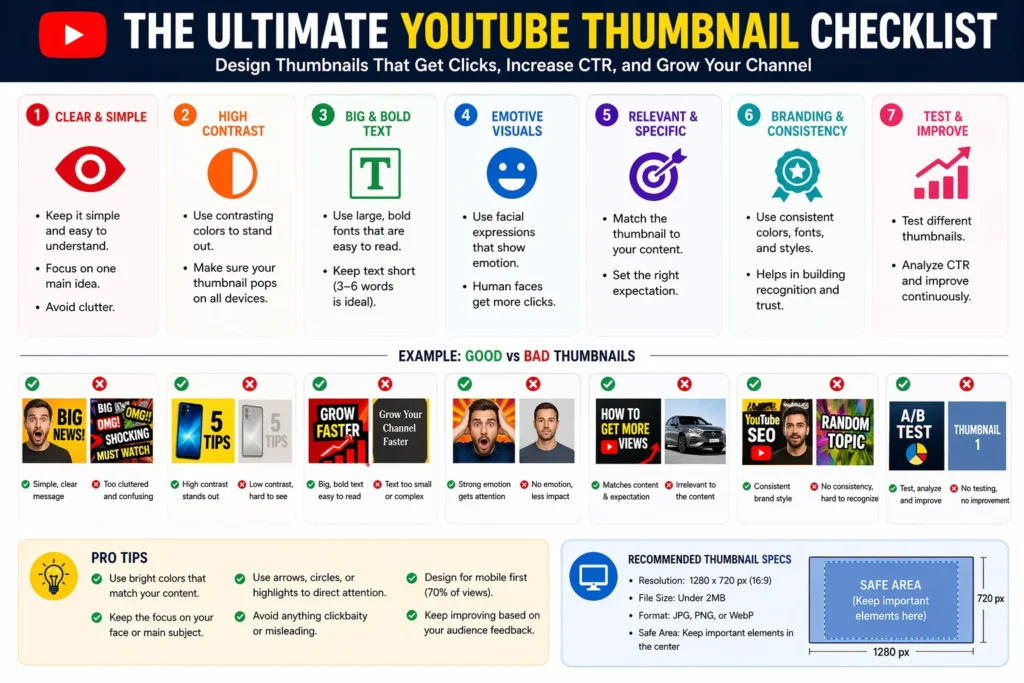
Run every title through this checklist before hitting “Publish.”
- Is the title under 60 characters?
- Is the primary keyword in the first 5 words?
- Does the title offer a specific “payoff” or benefit?
- Is there a power word that triggers emotion or curiosity?
- Does the title complement (not repeat) the thumbnail text?
- Are there brackets or parentheses to add context?
- Is the title written in the language my audience uses?
- Does the video content actually deliver on this title?
- Is the first 40 characters the most compelling part?
- Have I drafted at least 3 versions of this title?
Frequently Asked Questions About YouTube Titles
Conclusion
Writing great YouTube titles is not a talent you are born with; it is a repeatable skill you develop through testing and data. By following these YouTube title best practices, you move away from “hope-based” publishing and toward a strategic growth model.
Remember, your title is a bridge. On one side is the viewer’s problem or curiosity, and on the other side is your video’s solution. If the bridge is weak, nobody crosses. If it’s strong, keyword-optimized, and psychologically compelling, your channel’s growth becomes inevitable.
Next Step: Choose 3 of your worst-performing videos from the last 90 days. Use the 10-item checklist in Section 13 to rewrite their titles today. Watch your analytics for the next two weeks—you might just see those “dead” videos come back to life.