What are You Looking For?
Trending News

If you’re wondering how YouTubers get brand deals in India, the answer is simpler than most people think: brands look for creators who have an engaged audience, publish consistently, and can genuinely influence buying decisions. You don’t need millions of subscribers to land your first sponsorship. In fact, many Indian creators with just a few thousand subscribers earn through product collaborations, affiliate partnerships, and paid brand integrations because they serve a specific audience that brands want to reach.
India’s creator economy has expanded rapidly over the past few years, with influencer marketing becoming one of the fastest-growing digital advertising channels. Industry reports from organizations such as EY and IAMAI show that brands are increasingly shifting marketing budgets toward creator-led campaigns, especially for YouTube, Instagram, and short-form video platforms. As competition grows, brands are also moving beyond celebrity influencers and actively partnering with nano and micro creators who deliver stronger engagement and better return on investment.
Throughout this guide, we’ll occasionally reference Sourav Joshi Vlogs as a real-world example of how consistent content, audience trust, and long-term brand relationships can create sustainable sponsorship opportunities. His journey isn’t a blueprint everyone must follow, but it highlights the importance of building credibility before chasing sponsorship revenue.
Whether you’re a beginner hoping to land your first paid collaboration or an established creator looking to negotiate better deals, this guide walks you through every stage—from understanding sponsorships and setting your rates to writing winning pitches, reviewing contracts, avoiding scams, and staying compliant with Indian regulations.
SEE ALSO: YouTube Income Per 1,000 Views in India
What Are Brand Deals on YouTube, and How Do They Actually Work?
Quick answer: A YouTube brand deal is a paid collaboration where a company compensates a creator to promote its product, service, or campaign through videos, YouTube Shorts, or community content. Payment may be made in cash, products, affiliate commissions, or a combination of these.
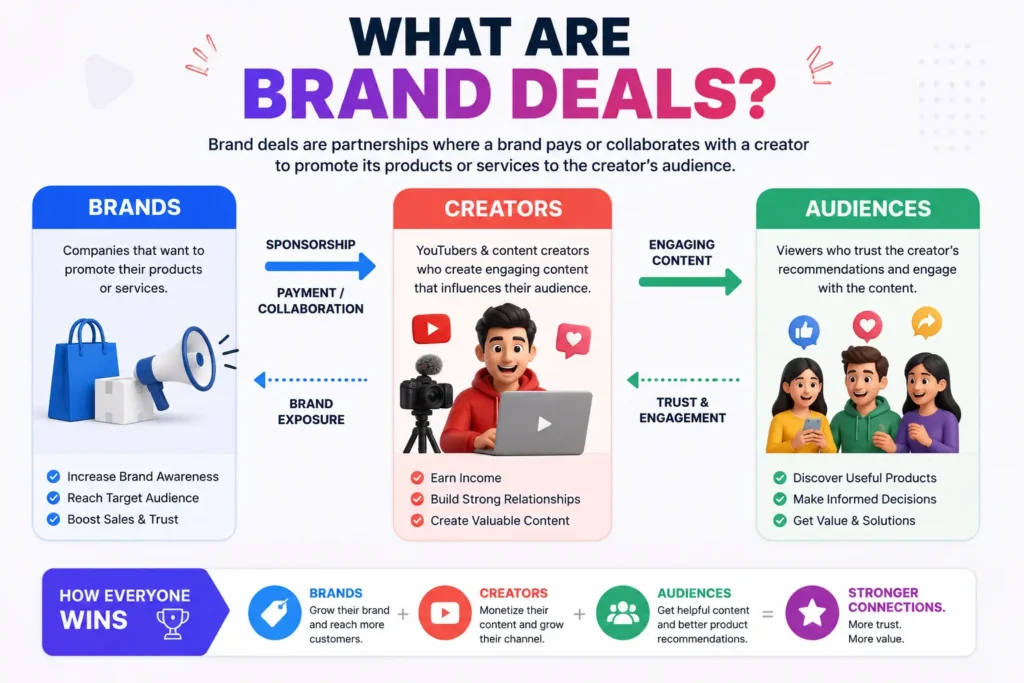
Unlike YouTube AdSense earnings, which come from advertisements shown by YouTube, brand sponsorships are negotiated directly between a creator and a business. The creator agrees to promote the brand according to specific campaign requirements, while the brand pays for access to the creator’s audience and influence.
Today, Indian companies—from D2C startups and fintech apps to automobile brands, beauty companies, SaaS businesses, and educational platforms—allocate significant marketing budgets to creator partnerships because audiences often trust recommendations from creators more than traditional advertisements.
The Basic Mechanics of a Sponsorship
Every sponsorship follows the same basic process.
A brand identifies creators whose audience matches its target customers. The creator receives a collaboration proposal—or reaches out proactively—and both parties discuss campaign objectives, pricing, deliverables, timelines, and usage rights.
Once both sides agree, the collaboration usually follows this workflow:
- Campaign discussion
- Price negotiation
- Contract signing
- Content creation
- Brand approval (if applicable)
- Publishing the video
- Performance reporting
- Payment
For example, a smartphone company launching a new budget device may partner with a technology YouTuber for a dedicated review, while a finance app may sponsor a productivity creator with a 60-second integration explaining how the app solves a common problem.
The objective isn’t simply to mention a product—it’s to create content that naturally fits the creator’s audience.
Brand Deals vs AdSense Earnings
| Feature | YouTube AdSense | Brand Deals |
|---|---|---|
| Who Pays? | YouTube | Brand |
| Income Source | Video advertisements | Sponsorship agreement |
| Earnings Depend On | Views, RPM, advertiser demand | Negotiated rate |
| Predictability | Variable | Fixed (usually) |
| Scalability | Limited by views | Based on influence and demand |
Many experienced creators eventually earn significantly more from sponsorships than from AdSense because a single collaboration can generate income equivalent to months of advertising revenue.
Common Types of Brand Deals in India
Not every collaboration involves a large cheque. Sponsorship opportunities evolve as your channel grows.
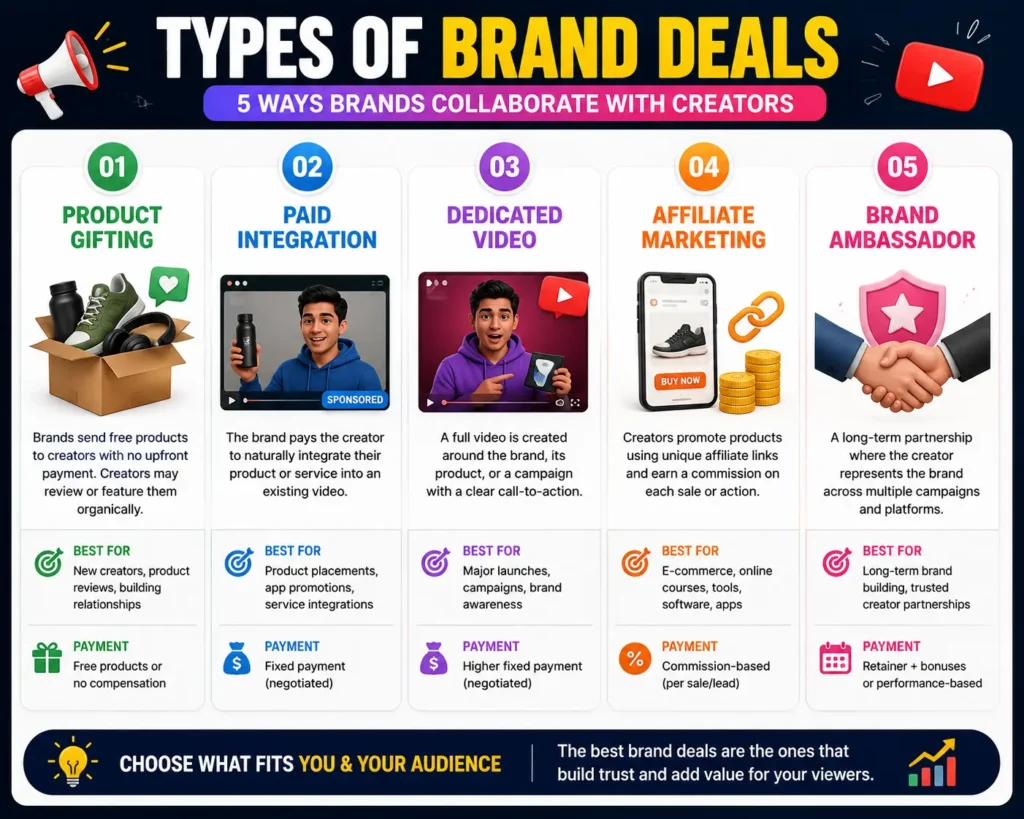
Product Gifting (Barter Deals)
Most Indian creators receive product-only collaborations before earning cash payments.
A skincare company might send products for review.
A gadget brand may offer a smartwatch.
A local restaurant could invite a food creator for a sponsored dining experience.
These collaborations help beginners build a sponsorship portfolio, although creators should understand that gifted products can have tax implications in India depending on the arrangement.
Flat-Fee Sponsored Integrations
This is the most common sponsorship model.
A creator includes a 60–90 second segment naturally within an existing video.
For example:
“This video is sponsored by…”
The payment is agreed before publishing and doesn’t depend on how many sales the brand generates.
Dedicated Sponsored Videos
Here, the entire video revolves around one product or service.
Examples include:
- Smartphone reviews
- App walkthroughs
- Educational platform demonstrations
- Software tutorials
Dedicated videos generally command significantly higher fees because the entire audience experience focuses on one brand.
Affiliate & Coupon Partnerships
Many Indian brands now combine sponsorships with affiliate marketing.
Instead of paying only a flat fee, brands may also offer:
- Commission on every sale
- Unique discount codes
- Revenue sharing
- Performance bonuses
Popular sectors include:
- Consumer electronics
- Beauty products
- Online learning
- Personal finance
- Software subscriptions
- Health & fitness
Affiliate partnerships work especially well for creators who have highly engaged audiences, even if their subscriber count is relatively small.
Long-Term Brand Ambassador Partnerships
Rather than commissioning a single sponsored video, many brands now prefer ongoing partnerships.
Instead of paying once, they collaborate with creators over several months through recurring campaigns.
This approach offers benefits for both parties:
For brands
- Better audience recall
- Higher trust
- Consistent messaging
For creators
- Predictable monthly income
- Less time spent finding sponsors
- Stronger professional relationships
Long-term partnerships have become increasingly common among Indian D2C brands looking to build sustained visibility rather than one-off promotions.
YouTube Shorts Sponsorships
Short-form content has opened another revenue stream.
Brands frequently sponsor:
- Product demonstrations
- Quick tips
- Before-and-after transformations
- Unboxing videos
- Lifestyle snippets
Although individual Shorts generally command lower sponsorship fees than long-form videos, creators who consistently generate millions of monthly Shorts views often earn competitive overall sponsorship income because of the sheer publishing volume.
How Do Brand Deals Actually Start?
Many new creators imagine brands randomly discovering channels with millions of subscribers.
In reality, sponsorships begin through several different routes.
A creator might:
- Send cold outreach emails
- Apply through influencer marketplaces
- Join a talent management agency
- Be contacted after publishing successful niche content
- Receive referrals from previous brand partners
- Get discovered through YouTube search or recommendations
As your content library grows, inbound opportunities become more common. Until then, proactive outreach usually produces faster results.
How Many Subscribers Do You Need to Get Sponsored in India?
Short answer: There is no minimum subscriber requirement for getting sponsored on YouTube in India. Brands increasingly evaluate audience quality, engagement, niche relevance, and content consistency instead of focusing only on subscriber count.
This is one of the biggest misconceptions among aspiring creators.
Many people believe they need 100,000 subscribers before approaching brands.
That’s simply not true.
A creator with 5,000 highly engaged subscribers in a profitable niche can often attract more sponsorship opportunities than a general entertainment channel with ten times the audience.
Why There’s No Fixed Subscriber Threshold
Over the past few years, Indian brands have shifted toward working with nano and micro creators because they often deliver:
- Higher engagement rates
- More authentic audience relationships
- Better conversion rates
- Lower acquisition costs
Instead of asking,
“How many subscribers do you have?”
marketing teams increasingly ask,
“Will your audience trust your recommendation?”
That change has opened sponsorship opportunities for thousands of smaller creators across India.
What Different Subscriber Levels Can Expect
| Subscriber Range | Typical Opportunities | Realistic for India |
|---|---|---|
| 0–1,000 | Affiliate links, local businesses, product gifting | Yes |
| 1K–10K | First paid collaborations, D2C brands, startups | Yes |
| 10K–100K | Regular sponsorships, recurring campaigns | Very common |
| 100K–500K | National campaigns, agency representation | Strong opportunities |
| 500K+ | Premium campaigns, ambassador deals, retainers | Highly competitive |
Remember, these aren’t rules—they’re common patterns observed across the Indian creator ecosystem.
Can You Get Sponsored With 1,000 Subscribers?
Absolutely.
Many Indian startups don’t need celebrity influencers.
They need creators whose audience matches their customers.
For example:
- A local café may collaborate with a food vlogger.
- A coaching institute may sponsor an education creator.
- A productivity app may partner with a student-focused YouTube channel.
- A regional clothing brand may work with a lifestyle creator serving one city or state.
If your audience is relevant, even a small channel can create measurable business results.
Why Niche Matters More Than Subscriber Count
Not every audience has the same commercial value.
A creator producing highly specialized finance content often attracts sponsorships from fintech companies, investment platforms, insurance brands, and financial services.
Similarly, technology creators frequently receive offers from smartphone manufacturers, laptop brands, SaaS companies, and gadget retailers.
On the other hand, broader entertainment niches may require significantly larger audiences before commanding comparable sponsorship rates because the audience is more diverse and less purchase-focused.
This is why experienced creators don’t just focus on growing subscribers—they focus on building authority within a clearly defined niche.
How Much Can Indian YouTubers Charge for Brand Deals? (2026 Rate Guide)
Quick answer: There isn’t a fixed sponsorship rate for YouTubers in India. Brands typically evaluate your average views, audience demographics, engagement rate, niche, content format, campaign objectives, and usage rights before deciding a budget. As a result, two creators with the same subscriber count can receive very different offers.
If you’re looking for a simple benchmark, think of subscriber count as the starting point—not the final pricing factor. A finance creator with 20,000 subscribers and strong engagement may command a higher rate than a general entertainment channel with 100,000 subscribers because the audience has greater commercial value.
Important: The pricing ranges below are indicative market estimates based on recent Indian creator economy trends, influencer marketing agency benchmarks, and publicly shared creator experiences. Sponsorship rates change frequently depending on demand, seasonality, niche, campaign goals, and negotiation. Always use them as a reference, not a guaranteed rate card.
Pricing Models Explained
Before discussing numbers, it’s important to understand how brands structure sponsorship payments. Not every collaboration follows the same pricing model.
Flat Fee Per Video
A flat-fee sponsorship is the most common arrangement in India.
The brand agrees to pay a fixed amount regardless of whether the video receives 20,000 views or 500,000 views.
This model works well when:
- The campaign has a fixed marketing budget.
- The creator has consistent viewership.
- The brand values audience trust more than raw impressions.
It’s also the simplest model for new creators because payment expectations are clear from the beginning.
CPM (Cost Per Thousand Views)
Some brands calculate sponsorship pricing using CPM (Cost Per Mille).
In simple terms:
Sponsorship Fee = (Expected Views ÷ 1,000) × Agreed CPM
For example:
- Expected views: 80,000
- Agreed CPM: ₹500
Estimated sponsorship fee:
80 × ₹500 = ₹40,000
Indian sponsorship CPMs generally vary based on niche and audience quality. Finance, B2B, SaaS, and technology channels usually attract higher CPMs than entertainment or general lifestyle channels.
CPV (Cost Per View)
Instead of estimating views beforehand, some campaigns pay based on the actual number of video views achieved within an agreed period, such as 30 days.
Although less common than flat-fee campaigns, CPV is occasionally used for product launches and app-install campaigns where measurable reach is the primary objective.
Affiliate or Commission-Based Deals
Many beginner creators start here.
Rather than paying an upfront sponsorship fee, brands offer:
- Sales commission
- Referral bonuses
- Coupon-code incentives
- Performance-based payouts
Affiliate partnerships are particularly popular among:
- SaaS companies
- Online learning platforms
- D2C brands
- Finance apps
- Consumer electronics
- Web hosting providers
The upside is unlimited earning potential. The downside is that your income depends entirely on conversions.
Hybrid Deals (Flat Fee + Performance Bonus)
Increasingly, Indian brands combine a guaranteed payment with performance incentives.
For example:
- ₹20,000 fixed sponsorship fee
- Plus ₹300 for every qualified lead
- Or bonus payments after reaching specific sales milestones
This model aligns the interests of both the creator and the brand. If the campaign performs well, everyone benefits.
India-Specific YouTube Sponsorship Rates by Subscriber Tier (2026)
The table below provides realistic sponsorship ranges commonly seen in the Indian market.
| Creator Tier | Subscribers | Integrated Mention | Dedicated Video |
|---|---|---|---|
| Nano | 1K–10K | ₹2,000–₹8,000 | ₹5,000–₹15,000 |
| Small | 10K–50K | ₹8,000–₹30,000 | ₹20,000–₹60,000 |
| Mid | 50K–200K | ₹25,000–₹80,000 | ₹60,000–₹2,00,000 |
| Large | 200K–1M | ₹75,000–₹3,00,000 | ₹2,00,000–₹8,00,000 |
| Mega | 1M+ | ₹3,00,000+ | ₹8,00,000+ |
Keep in mind:
- A creator averaging 300,000 views per video may charge more than another creator with twice the subscribers but weaker viewership.
- Long-term partnerships often reduce the per-video rate while increasing total annual income.
- Exclusive campaigns generally command higher pricing.
Sponsorship Rates by Content Format
Not every sponsored video requires the same amount of work.
Brands pay differently depending on how prominently they’re featured.
Integrated Mentions (60–90 Seconds)
This is the most common sponsorship format.
The creator naturally introduces the product during a regular video.
Typical pricing:
- Lowest production effort
- Higher audience retention
- Easier brand integration
Many Indian D2C brands prefer this format because it feels less promotional.
Dedicated Sponsored Videos
Here, the entire video focuses on one product or service.
Because the creator invests more time in planning, scripting, filming, and editing, dedicated sponsorships typically cost 3–5 times more than short integrations.
Brands also receive:
- Full audience attention
- Better storytelling
- Longer product exposure
- Higher conversion potential
YouTube Shorts Sponsorship Rates
Short-form content has become an important revenue stream for creators.
Typical market ranges:
| Shorts Performance | Typical Sponsorship Range |
|---|---|
| 10K–50K average views | ₹2,000–₹10,000 |
| 50K–200K views | ₹10,000–₹35,000 |
| 200K–1M views | ₹35,000–₹1,00,000+ |
While a single Short usually earns less than a long-form sponsorship, creators who consistently publish multiple high-performing Shorts each week can build significant monthly sponsorship revenue.
Long-Form vs. Shorts: Which Earns More?
There’s no universal winner.
Long-form videos usually generate:
- Higher sponsorship fees
- Better storytelling
- Greater audience trust
- Stronger conversion rates
Shorts, on the other hand, offer:
- Faster production
- Higher publishing frequency
- Greater discovery potential
- More campaign volume
Many successful Indian creators combine both formats. Long-form content builds authority, while Shorts increase visibility and create additional sponsorship inventory.
Sponsorship Rates by Niche
Your niche can influence pricing just as much as your subscriber count.
Industries with higher customer lifetime value typically allocate larger influencer marketing budgets.
| Niche | Relative Rate Potential |
|---|---|
| Personal Finance | ⭐⭐⭐⭐⭐ |
| Technology & Gadgets | ⭐⭐⭐⭐⭐ |
| SaaS & Business | ⭐⭐⭐⭐⭐ |
| Real Estate | ⭐⭐⭐⭐☆ |
| Automobile | ⭐⭐⭐⭐☆ |
| Education | ⭐⭐⭐⭐☆ |
| Health & Fitness | ⭐⭐⭐⭐☆ |
| Beauty & Skincare | ⭐⭐⭐⭐☆ |
| Gaming | ⭐⭐⭐☆☆ |
| Food | ⭐⭐⭐☆☆ |
| Travel | ⭐⭐⭐☆☆ |
| Lifestyle & Vlogging | ⭐⭐☆☆☆ |
| Comedy & Entertainment | ⭐⭐☆☆☆ |
Why the difference?
A finance app may acquire a customer worth thousands of rupees over several years, making it worthwhile to pay creators higher sponsorship fees.
By comparison, an entertainment-focused campaign often depends on massive reach rather than highly targeted conversions.
What Actually Increases Your Sponsorship Rate?
Subscriber count is only one piece of the puzzle.
Experienced creators know that brands evaluate the complete picture.
1. Average Views Matter More Than Viral Videos
A channel consistently receiving 60,000 views per upload is often more valuable than one that alternates between 5,000 and 500,000 views.
Predictable performance reduces campaign risk for brands.
2. Audience Geography
Brands often pay a premium for audiences located in:
- Delhi NCR
- Mumbai
- Bengaluru
- Hyderabad
- Pune
- Chennai
Similarly, channels with a significant NRI audience may attract international campaigns with higher budgets.
3. Engagement Rate
Comments, shares, saves, likes, and audience interaction demonstrate trust.
A creator with an active community usually delivers stronger campaign performance than one with passive subscribers.
4. Audience Demographics
Brands care about:
- Age
- Gender
- Interests
- Purchasing power
- Language
- Geographic distribution
Your YouTube Studio analytics become extremely valuable during sponsorship negotiations.
5. Usage Rights
One of the most overlooked pricing factors is content usage rights.
If a brand wants to:
- Run your video as paid advertising
- Repost it on their social channels
- Use clips on their website
- Feature your content in future campaigns
they should generally pay an additional licensing fee.
Unlimited usage rights bundled into a basic sponsorship fee often undervalue your work.
6. Exclusivity
Suppose a smartphone brand asks you not to work with competing brands for six months.
That restriction could prevent multiple future collaborations.
Longer exclusivity periods should almost always justify higher compensation.
7. Production Complexity
A talking-head integration requires less effort than:
- Travel shoots
- Cinematic productions
- Drone footage
- Multi-location filming
- Extensive editing
- Professional voice-over work
Higher production costs should be reflected in your pricing.
A Simple Formula for Pricing Your First Brand Deal
If you’re unsure what to quote, start with these questions:
- How many views do my recent videos average?
- How valuable is my niche?
- How much production work is required?
- Will the brand receive usage rights?
- Is there an exclusivity clause?
- Is this a one-time campaign or a long-term partnership?
Instead of immediately accepting the first offer, ask the brand:
“Could you please share your campaign objectives and budget range?”
This simple question often reveals whether the company has flexibility before you mention your own pricing.
Should Beginners Charge Less?
To a point, yes.
If you’ve never completed a sponsorship before, your first collaboration is also a portfolio-building opportunity.
That doesn’t mean working for free indefinitely.
Instead:
- Accept fair introductory pricing.
- Deliver exceptional results.
- Collect testimonials.
- Request performance feedback.
- Increase your rates gradually as your credibility grows.
Many successful creators doubled or tripled their sponsorship rates within a year simply because they consistently demonstrated results.
Before You Send a Quote…
Make sure you can justify your pricing with data.
Your media kit should include:
- Average video views
- Audience demographics
- Engagement metrics
- Previous collaborations
- Testimonials (if available)
- Deliverables included in your pricing
Brands are far more likely to accept your quote when it’s backed by evidence rather than just a subscriber count.
How Do YouTubers Get Brand Deals in India? (Step-by-Step Process)
Quick answer: Most Indian YouTubers get brand deals by building a niche-focused channel, creating a professional media kit, identifying brands that already work with creators, reaching out with personalized pitches, negotiating fair terms, and consistently delivering strong campaign results. While some sponsorships come through agencies or inbound inquiries, direct outreach remains one of the fastest ways for small and growing creators to secure their first paid collaborations.
If you’ve been waiting for brands to magically discover your channel, you’re likely slowing down your growth. Successful creators treat sponsorships like business development—they actively look for opportunities instead of waiting for them.
Here’s a practical six-step process that works whether you have 2,000 subscribers or 200,000.
Step 1 – Make Your Channel Sponsor-Ready
Before you contact a single brand, take an honest look at your YouTube channel through the eyes of a marketing manager.
Ask yourself:
“If I were investing ₹50,000 in this creator, would I feel confident?”
If the answer isn’t an immediate “yes,” fix the basics first.
Sponsor-Ready Channel Checklist
✅ Clear niche and content focus
✅ Professional channel banner and profile photo
✅ Easy-to-find business email in the About section
✅ Consistent upload schedule
✅ High-quality thumbnails
✅ Strong titles and descriptions
✅ At least 3–5 high-quality videos that represent your best work
✅ Active engagement with viewers through comments and community posts
Brands rarely sponsor channels that appear abandoned or inconsistent. Even if your audience is small, a well-maintained channel sends the message that you’re reliable.
Build a Portfolio Before Chasing Sponsors
One mistake many beginners make is reaching out after uploading only two or three videos.
Instead, create a small library of content first.
Aim for:
- 15–20 videos minimum
- Consistent branding
- Clear editing style
- Stable viewership trends
- Demonstrated audience engagement
Think of your channel as your portfolio. Every video should reinforce why a brand should trust you.
Step 2 – Build a List of Brands That Match Your Audience
Don’t pitch every company you recognize.
The best sponsorships happen when your audience already aligns with the brand’s target customers.
Start With Brands Already Sponsoring Creators
A simple strategy is to study creators in your niche.
Watch their recent videos and note:
- Sponsor mentions
- Affiliate links
- Discount codes
- Brand logos
- Product integrations
If a company is already investing in YouTube creators, there’s a good chance it’s open to new partnerships.
Build a Target List
Aim to create a spreadsheet with 50–100 potential brands.
Include columns such as:
| Brand | Industry | Contact Person | Campaign Notes | Status |
|---|
Over time, this becomes your sponsorship pipeline rather than relying on random opportunities.
Prioritize Brands in Growing Indian Sectors
Some industries are especially active in creator marketing.
Examples include:
- D2C skincare and personal care
- Consumer electronics
- Mobile accessories
- Fintech apps
- Online learning platforms
- SaaS products
- Fitness brands
- Nutrition products
- Fashion and lifestyle
- Travel services
- Food delivery
- Productivity tools
You don’t need to guess which brands spend on creators—look at who is already sponsoring channels similar to yours.
Step 3 – Find the Right Decision Maker
Many sponsorship opportunities are lost because creators send emails to generic customer support addresses.
Instead, find the people responsible for influencer marketing.
Look for job titles such as:
- Influencer Marketing Manager
- Brand Manager
- Digital Marketing Manager
- Partnerships Manager
- Marketing Lead
- Growth Marketing Manager
Where to Find Contacts
Try these sources:
- Company website
- Press page
- Media page
- Brand Instagram profile
- PR agencies
- Marketing agencies representing the brand
If you can’t find an email address, LinkedIn is often your best option for identifying the right person before searching for their professional contact information.
Step 4 – Send a Personalized Pitch
Now it’s time to introduce yourself.
Avoid sending the same generic message to every company.
A good sponsorship pitch should answer four questions quickly:
- Who are you?
- Why are you contacting this brand?
- Why is your audience relevant?
- What action should they take next?
Instead of writing:
“Hi, I want to collaborate.”
Write something like:
“I’ve been using your productivity app for several months and recently created a video about study workflows that reached 85,000 students. I believe a collaboration would be valuable because our audiences overlap naturally.”
Specificity immediately separates your email from hundreds of generic outreach messages.
(We’ll cover complete sponsorship email templates later in this guide.)
Step 5 – Negotiate Before You Say Yes
Receiving an offer doesn’t mean accepting the first number.
Professional creators negotiate respectfully.
Before agreeing, clarify:
- Deliverables
- Number of revisions
- Publishing deadline
- Payment timeline
- Usage rights
- Exclusivity period
- Disclosure requirements
- Reporting expectations
If the scope expands during discussions, your pricing should too.
For example:
A brand initially requests:
- One integrated mention
Later they ask for:
- One Instagram Reel
- Three Story posts
- Thumbnail branding
- Six months of advertising rights
That’s no longer the same project.
Always renegotiate when deliverables change.
Step 6 – Deliver Results and Build Long-Term Relationships
Many creators think the sponsorship ends after publishing the video.
The best creators know that’s when the relationship begins.
A few days after the campaign goes live, send the brand a short performance summary.
Include metrics such as:
- Total views
- Watch time
- Likes
- Comments
- Click-through rate (if available)
- Affiliate sales (if applicable)
- Audience feedback
This simple follow-up demonstrates professionalism and often leads to repeat campaigns.
Long-term partnerships are usually more valuable than constantly chasing new sponsors.
Alternative Ways to Get Brand Deals
Direct outreach isn’t the only option.
As your channel grows, sponsorship opportunities may come through several different channels.
YouTube BrandConnect
YouTube BrandConnect helps eligible creators connect with advertisers running campaigns on YouTube.
Instead of contacting brands individually, creators can participate in campaigns managed through Google’s ecosystem.
Availability and eligibility vary by country and channel requirements, so check the latest eligibility guidelines before relying on this route.
Influencer Marketing Platforms
Creator marketplaces connect brands with influencers across different niches.
These platforms allow brands to:
- Search creators
- Filter by audience demographics
- Compare engagement metrics
- Send collaboration invitations
Benefits include:
- Easier discovery
- Standardized campaign workflow
- Faster communication
Potential drawbacks include:
- Platform commissions
- Increased competition
- Less control over negotiations
Talent Management Agencies
As creators grow, many sign with talent management agencies.
An agency typically helps with:
- Finding sponsorships
- Rate negotiation
- Contract review
- Campaign management
- Invoicing
- Long-term partnership development
In return, agencies generally earn a percentage of each completed deal.
Pros
- Less administrative work
- Access to premium campaigns
- Professional negotiation
- Stronger brand network
Cons
- Commission on earnings
- Less direct control
- Possible exclusivity agreements
For creators receiving frequent sponsorship inquiries, agency representation can save significant time.
Organic Inbound Opportunities
Eventually, brands may contact you directly.
This usually happens after you’ve built:
- Consistent viewership
- Recognizable expertise
- Audience trust
- Strong search visibility
- Active social media presence
Inbound sponsorships often convert more easily because the brand has already decided you’re a potential fit.
Which Brands Work With Small and Nano YouTubers in India?
One of the biggest myths in creator marketing is that only famous YouTubers get sponsorships.
In reality, thousands of Indian brands actively work with creators who have fewer than 10,000 subscribers.
Their priority isn’t fame—it’s reaching the right audience.
Categories That Frequently Work With Small Creators
Direct-to-Consumer (D2C) Brands
D2C businesses rely heavily on influencer marketing because it often costs less than traditional advertising.
Common examples include:
- Skincare
- Haircare
- Fashion
- Nutrition
- Home products
- Kitchen products
These companies frequently collaborate with nano creators who produce authentic product demonstrations.
Mobile Apps
Apps constantly need new users.
Popular categories include:
- Personal finance
- Budget tracking
- Investing
- Learning
- Productivity
- Language learning
- Gaming
- Fitness
Many app companies combine fixed payments with referral bonuses.
Local Businesses
Don’t overlook businesses in your own city.
Examples include:
- Restaurants
- Cafés
- Gyms
- Coaching institutes
- Photography studios
- Clothing boutiques
- Travel agencies
Local sponsorships often become your first paid collaborations.
SaaS Companies
Software businesses frequently partner with niche creators.
Especially if your audience includes:
- Students
- Entrepreneurs
- Freelancers
- Designers
- Developers
- Small business owners
These campaigns often include recurring affiliate commissions alongside sponsorship fees.
How to Find Brands Already Working With Creators Like You
Instead of guessing, research your niche.
Here’s a practical method:
Search YouTube
Look for creators similar to your size.
Watch:
- Recent uploads
- Sponsor mentions
- Video descriptions
- Affiliate links
If multiple creators are promoting the same company, that’s a strong indicator the brand actively invests in influencer marketing.
Search Instagram
Use hashtags like:
- #ad
- #sponsored
- #collab
- #partnership
Combine them with niche keywords.
For example:
- #TechReview
- #FitnessIndia
- #FinanceCreator
- #FoodBloggerIndia
You’ll quickly identify brands running creator campaigns.
Monitor Competitors
Don’t copy other creators.
Instead, study patterns.
Questions to ask:
- Which brands appear repeatedly?
- Which campaigns seem long-term?
- Which creators receive repeat collaborations?
Patterns reveal where marketing budgets already exist.
Can Brands Sponsor Channels Under 10,000 Subscribers?
Yes.
In fact, many brands intentionally allocate part of their influencer budget to nano creators because:
- Engagement rates are often higher.
- Audiences feel more connected.
- Campaign costs are lower.
- Recommendations appear more authentic.
If your content consistently solves a problem or serves a well-defined audience, your subscriber count becomes much less important than your ability to influence purchasing decisions.
How to Write a YouTube Sponsorship Pitch That Gets Replies
Quick answer: A strong sponsorship pitch is short, personalized, data-driven, and focused on the brand’s goals—not your need for a sponsor. Introduce yourself, explain why your audience is a good fit, share relevant performance metrics, and end with a clear, low-friction call to action.
One of the biggest reasons creators never hear back from brands isn’t their subscriber count—it’s the quality of their outreach.
Marketing managers receive dozens, sometimes hundreds, of collaboration requests every week. Most of them look almost identical:
“Hi, I’m a YouTuber. I want to collaborate with your brand.”
That email gives the brand no reason to continue reading.
A good pitch answers one question immediately:
“Why should this brand work with you instead of someone else?”
What Every Sponsorship Pitch Should Include
Before writing your email, gather the information a brand actually wants to see.
1. A Clear Subject Line
Avoid vague subjects like:
- Collaboration
- Partnership
- Brand Deal
- Sponsorship Request
Instead, make it specific.
Good examples:
- Collaboration Opportunity – Tech YouTube Channel (52K Subscribers)
- Brand Partnership Proposal for [Brand Name]
- YouTube Sponsorship Opportunity – Personal Finance Audience
- Creator Collaboration Proposal for [Brand Name]
A clear subject line improves the chances of your email being opened.
2. A Short Introduction
The first paragraph should quickly explain:
- Who you are
- What your channel covers
- Who your audience is
Example:
Hi Sarah, I’m Arun, the creator behind a YouTube channel focused on affordable smartphone reviews and technology buying guides for Indian consumers. My audience mainly consists of viewers aged 18–34 who are actively researching gadgets before making purchase decisions.
This tells the brand far more than simply stating your subscriber count.
3. Explain Why You’re Contacting That Brand
Personalization is what separates a professional pitch from a mass email.
Instead of saying:
I’d love to collaborate.
Try:
I’ve noticed your recent campaign promoting budget smartphones, and I believe it aligns well with my audience, who regularly watch comparison and buying guide videos before purchasing.
This demonstrates genuine research.
4. Share Relevant Performance Metrics
Don’t overwhelm brands with every statistic available.
Focus on the numbers that help them evaluate campaign potential.
Include:
- Subscribers
- Average views per video
- Engagement rate
- Audience location
- Audience age group
- Upload frequency
Example:
- 28,500 subscribers
- Average 42,000 views per upload
- 8.3% engagement rate
- 92% Indian audience
- Three uploads every week
Quality matters more than quantity.
5. Include a Media Kit
Never make brands ask for your media kit.
Attach it or include a cloud storage link.
Your media kit should answer questions before they’re asked.
We’ll cover exactly what belongs in a media kit later in this guide.
6. End With a Simple Call to Action
Avoid making your email feel like a sales pitch.
Instead of:
Please sponsor me.
Try:
If you’re currently planning creator collaborations, I’d be happy to discuss campaign ideas that align with your goals.
Professional. Confident. Easy to respond to.
Cold Sponsorship Email Template (Copy & Paste)
Subject: YouTube Collaboration Proposal – [Your Niche]
Hi [First Name],
My name is [Your Name], and I run a YouTube channel focused on [your niche].
My audience primarily consists of [describe audience], and my videos typically receive around [average views] with an engagement rate of approximately [engagement rate].
I’ve been following [Brand Name] for some time, particularly your recent [campaign/product], and I believe it would genuinely resonate with my audience.
I’d love to explore a collaboration where I can naturally introduce your product through content that provides value rather than feeling like an advertisement.
I’ve attached my media kit, which includes audience demographics, channel statistics, previous collaborations, and available partnership options.
If you’re interested, I’d be happy to discuss ideas that fit your upcoming campaigns.
Looking forward to hearing from you.
Best regards,
[Name]
[Email]
[Phone]
[Channel Link]
Warm Outreach Template (For Brands You Already Use)
This version generally performs better because authenticity is easier to demonstrate.
Subject: I’ve Been Using [Brand Name] – Collaboration Idea
Hi [First Name],
I’m [Your Name], and I create YouTube videos about [niche].
I’ve genuinely been using [product/service] for the past few months and have mentioned it organically in conversations with my audience.
Since many of my viewers frequently ask for recommendations in this category, I thought it would be worth exploring an official collaboration.
My channel currently has:
- [Subscribers]
- [Average Views]
- [Audience Location]
- [Engagement Rate]
I’ve attached my media kit for reference.
If you’re currently working with creators, I’d love to discuss how we can create content that benefits both your brand and my audience.
Thank you for your time.
Best regards,
[Name]
Common Pitch Mistakes That Get Ignored
Even experienced creators occasionally make these mistakes.
Avoid them whenever possible.
Sending the Same Email to Every Brand
Brands can immediately recognize a copy-paste email.
If the message could be sent to any company without changing a word, it isn’t personalized enough.
Spend five minutes researching the brand before writing.
That small investment dramatically increases your response rate.
Talking Only About Yourself
Remember:
Brands care about results.
Instead of focusing only on your achievements, explain how you can help them reach potential customers.
Shift the conversation from:
“Here’s why I’m great.”
to
“Here’s how I can help your campaign succeed.”
Not Including Performance Data
Marketing teams make decisions using data.
Without metrics, they have no way to estimate campaign performance.
Always include:
- Average views
- Audience demographics
- Engagement
- Niche
- Audience location
Asking for “Any Collaboration”
This sounds uncertain.
Instead, suggest a specific content idea.
For example:
I’d love to create a comparison video featuring your new wireless earbuds as part of my monthly budget gadget recommendations.
Specific ideas are easier to evaluate.
Forgetting Contact Information
It sounds obvious—but many creators accidentally omit:
- Business email
- Phone number
- Channel link
- Media kit
Make replying as easy as possible.
Follow-Up Etiquette
Most sponsorship emails don’t receive an immediate response.
That doesn’t necessarily mean the brand isn’t interested.
Marketing teams are busy.
A polite follow-up often works.
Recommended Timeline
| Time | Action |
|---|---|
| Day 1 | Send initial pitch |
| Day 6–7 | Send one polite follow-up |
| Day 14 | If there’s still no reply, move on |
Avoid sending daily reminders.
Professional persistence is appreciated.
Pressure isn’t.
Example Follow-Up Email
Hi [Name],
Just following up on my previous email regarding a potential collaboration.
I know you’re busy, so I wanted to check whether you’ve had a chance to review my proposal.
If your team is currently planning creator campaigns, I’d be happy to discuss ideas that fit your upcoming marketing goals.
Thank you for your time.
Best,
[Name]
One follow-up is usually enough.
If the brand doesn’t respond after that, continue building relationships elsewhere.
How to Create a Media Kit That Wins Brand Deals
Quick answer: A creator media kit is a concise document that showcases your audience, channel performance, previous work, and collaboration opportunities. It helps brands evaluate whether you’re the right fit without needing multiple emails.
Think of your media kit as your professional résumé.
When a brand receives your pitch, this is usually the second thing they’ll open.
A weak media kit can cost you opportunities—even if your channel is excellent.
Why Brands Ask for a Media Kit
Brands don’t just want subscriber numbers.
They want to understand:
- Who watches your videos
- Whether your audience matches their target customers
- How your previous content performs
- What types of collaborations you offer
- How to contact you
A well-designed media kit answers these questions within a couple of minutes.
What Every Creator Media Kit Should Include
1. Cover Page
Start with:
- Your name
- Channel name
- Professional photo (optional but recommended)
- Niche
- Short creator introduction
- Contact details
Keep it clean and visually consistent with your YouTube branding.
2. Audience Demographics
This is one of the first sections brands review.
Include:
- Age distribution
- Gender split
- Top countries
- Top Indian cities
- Languages
- Viewer interests
If your audience includes a high percentage of viewers from metro cities like Delhi, Mumbai, Bengaluru, Hyderabad, or Pune, highlight that clearly. Many advertisers consider this valuable when planning regional campaigns.
3. Performance Metrics
Don’t overload this page.
Focus on meaningful numbers.
Include:
- Subscribers
- Monthly views
- Average views per upload
- Watch time
- Engagement rate
- Upload frequency
Whenever possible, use screenshots from YouTube Studio to support your claims.
4. Previous Collaborations
If you’ve already worked with brands, showcase them.
Include:
- Brand logos (with permission)
- Campaign objectives
- Results achieved
- Testimonials (if available)
What if you’re a beginner?
That’s perfectly fine.
Instead of sponsorships, feature:
- Your top-performing videos
- Audience comments
- Organic product mentions
- Successful affiliate campaigns
Brands care about evidence of influence, not just previous sponsorships.
5. Rate Card
Include a simple pricing overview.
For example:
| Deliverable | Starting Price |
|---|---|
| YouTube Shorts | ₹7,500 |
| Integrated Mention | ₹15,000 |
| Dedicated Video | ₹40,000 |
| Community Post | ₹5,000 |
You don’t have to publish exact prices if you prefer negotiating.
You can simply write:
Custom pricing available based on campaign requirements.
6. Contact Information
Finish with:
- Business email
- Phone number (optional)
- YouTube link
- LinkedIn (if relevant)
- Website (if applicable)
Make it easy for brands to reach you.
Media Kit Design Tips
A beautiful design won’t compensate for weak content—but poor design can reduce credibility.
Keep these best practices in mind:
- Limit the document to 1–2 pages.
- Use consistent fonts and spacing.
- Include only updated statistics.
- Refresh your analytics every quarter.
- Use high-resolution screenshots from YouTube Studio.
- Avoid unnecessary graphics that distract from your data.
- Export the final version as a PDF for easy sharing.
Remember, your media kit should support your pitch—not overwhelm it.
Pro Tip: Treat Your Media Kit as a Living Document
Your channel evolves every month, and your media kit should evolve with it.
Review it regularly and update:
- Subscriber count
- Average views
- Audience demographics
- New collaborations
- Testimonials
- Pricing
A current media kit signals professionalism and saves you from manually answering the same questions for every potential sponsor.
How Do YouTube Sponsorship Contracts Work?
Quick answer: A YouTube sponsorship contract is a legally binding agreement between a creator and a brand that outlines what content will be delivered, when it will be published, how much the creator will be paid, and how the content can be used. Before signing, every creator should understand payment terms, usage rights, exclusivity, disclosure requirements, and cancellation clauses.
Landing a sponsorship is exciting—but don’t let that excitement push you into signing the first contract you receive.
Many creators focus only on the payment amount, while experienced creators know that the contract often matters more than the fee itself.
A ₹50,000 campaign with fair terms can be more valuable than a ₹1,00,000 campaign that restricts your future work or gives away unlimited rights to your content.
Key Clauses Every Indian Creator Should Understand
Before signing any sponsorship agreement, read every clause carefully—even if the contract looks like a standard template.
Deliverables and Timeline
This section defines exactly what you’re expected to produce.
It should clearly mention:
- Number of videos
- Video format (Shorts or long-form)
- Minimum duration
- Key talking points
- Mandatory product mentions
- Call-to-action requirements
- Posting deadlines
- Number of revision rounds
If anything is vague, ask for clarification before signing.
For example, instead of:
“Create promotional content.”
The agreement should specify:
“One YouTube video (8–10 minutes) including a 90-second product integration and one Community post.”
Specific deliverables reduce misunderstandings later.
Payment Terms
Never assume payment details are “understood.”
The contract should answer questions such as:
- How much will you be paid?
- Is GST included or additional?
- Will TDS be deducted?
- When will payment be made?
- Which payment method will be used?
- Is there an advance payment?
Many professional creators request:
- 30–50% advance before production
- Remaining balance within an agreed number of days after publishing
Always request an invoice or written payment confirmation.
Usage Rights
This is one of the most overlooked contract clauses.
Brands may ask permission to:
- Post your video on their website
- Share clips on Instagram
- Run your content as paid advertisements
- Feature your content in presentations
- Use your image in future campaigns
These are usage rights.
If a brand wants extensive usage rights—especially for paid advertising—you should generally charge an additional licensing fee.
Unlimited usage shouldn’t automatically be included in your standard sponsorship price.
Exclusivity Clauses
An exclusivity clause limits your ability to work with competing brands.
Example:
A smartphone company may ask you not to promote another smartphone brand for three months.
That sounds reasonable.
But imagine a contract saying:
“The creator may not collaborate with any electronics brand for one year.”
That restriction could prevent multiple future sponsorship opportunities.
Ask yourself:
- Which competitors are included?
- How long does exclusivity last?
- Does it apply only in India?
- Is additional compensation offered?
The broader the restriction, the higher the compensation should usually be.
Content Approval Process
Some brands approve content before publishing.
Others simply provide guidelines.
Clarify:
- Will the script require approval?
- Can the brand request edits?
- How many revisions are included?
- Who gives final approval?
Unlimited revision requests can quickly turn a simple campaign into weeks of extra work.
Disclosure Requirements
Most professional brands require sponsorship disclosures.
These may include:
- YouTube Paid Promotion label
- Written sponsorship disclosure
- Hashtags such as #ad or #sponsored
- Compliance with Indian advertising guidelines
These disclosures protect both the creator and the audience by making commercial relationships transparent.
Cancellation and Termination
Sometimes campaigns don’t go as planned.
Your contract should explain:
- What happens if the campaign is cancelled?
- Who owns completed content?
- Will production costs be reimbursed?
- What happens if deadlines change?
Clear cancellation terms protect both parties.
Sponsorship Contract Red Flags
Some contracts deserve extra caution.
Watch for warning signs such as:
🚩 No written agreement
🚩 Payment amount not clearly mentioned
🚩 No payment deadline
🚩 Unlimited content usage without additional compensation
🚩 Excessive exclusivity periods
🚩 Unlimited revision requests
🚩 Extremely vague deliverables
🚩 Requests for passwords or YouTube account access
🚩 Pressure to sign immediately
🚩 Requests to pay any “registration” or “processing” fee
If something feels unclear, ask questions.
Professional brands expect reasonable discussion before signing.
Should You Hire a Lawyer?
Not every sponsorship requires legal review.
For smaller collaborations, carefully reading the agreement may be sufficient.
However, if you’re signing:
- High-value contracts
- Long-term ambassador agreements
- Exclusive partnerships
- Multi-platform campaigns
- Licensing agreements
- International contracts
consider having the document reviewed by a lawyer experienced in media, advertising, or intellectual property.
The cost of a professional review is often much lower than the cost of correcting a bad agreement later.
Note: This section provides general educational information and should not be considered legal advice. For significant commercial agreements, consult a qualified legal professional.
Legal, Tax & Compliance for Indian YouTube Sponsorships
One of the fastest ways to damage your reputation as a creator is to ignore legal and tax responsibilities.
As sponsorship income grows, you’re no longer just making videos—you are operating a business.
Understanding the basics of disclosure, taxation, and invoicing helps you build long-term relationships with brands while avoiding unnecessary compliance issues.
Important: The information below is intended for general awareness only and should not be treated as legal or tax advice. Tax laws and regulatory requirements can change. Always consult a Chartered Accountant (CA) or legal professional before making financial decisions.
ASCI Disclosure Guidelines for Influencers
The Advertising Standards Council of India (ASCI) requires influencers to clearly disclose promotional relationships so audiences can distinguish advertisements from organic content.
If you’re receiving:
- Payment
- Free products
- Gifts
- Discounts
- Travel
- Complimentary services
- Any other material benefit
the relationship may require a disclosure, depending on the nature of the collaboration and the applicable guidelines.
Good Disclosure Practices
Make disclosures:
- Easy to notice
- Easy to understand
- Visible without searching
- Appropriate for the platform
On YouTube, creators commonly combine:
- The platform’s Paid Promotion label
- A verbal disclosure within the video
- A written disclosure in the description
Transparency builds audience trust.
Trying to hide a sponsorship usually has the opposite effect.
Do You Need GST Registration?
Many creators ask:
“Do YouTubers need GST?”
The answer depends on your business structure, turnover, location, and applicable GST rules—not on the fact that you’re a YouTuber.
If your creator income grows significantly, GST registration may become applicable.
Factors that can influence this include:
- Annual turnover
- Nature of services
- Place of supply
- Business registration
Because GST rules can vary depending on your circumstances, consult a Chartered Accountant before registering or assuming you’re exempt.
Understanding TDS and Section 194R
Many creators receive free products instead of cash.
Examples include:
- Smartphones
- Laptops
- Furniture
- Cameras
- Hotel stays
- Event invitations
These are commonly called barter collaborations.
In India, barter arrangements can have tax implications, and in certain situations, businesses providing benefits or perquisites may have obligations under Section 194R of the Income-tax Act.
What this means for creators is simple:
Receiving a “free” product doesn’t automatically mean there are no tax consequences.
If you’re regularly accepting expensive gifts or barter deals, speak with your tax advisor to understand your reporting obligations.
Should Sponsorship Income Be Reported?
In most cases, sponsorship earnings should be properly reported in your income tax return under the applicable provisions based on your individual circumstances.
Depending on factors such as:
- Business structure
- Nature of activities
- Frequency of income
- Professional status
creator income may be treated differently for tax purposes.
Rather than guessing, maintain:
- Proper invoices
- Payment records
- Bank statements
- Contracts
- Expense receipts
Good bookkeeping makes tax filing significantly easier.
Best Practices for Professional Creators
As your sponsorship income grows, consider treating your YouTube channel like a business.
Helpful habits include:
- Maintaining separate business records
- Saving every sponsorship contract
- Issuing professional invoices
- Tracking campaign payments
- Recording business expenses
- Keeping analytics reports for completed campaigns
Professional documentation also makes you more credible when working with larger brands.
How to Avoid Brand Deal Scams in India
The creator economy has grown rapidly—and unfortunately, so have sponsorship scams.
Scammers know that many creators are eager to land their first collaboration.
They use that excitement to steal money, personal information, or even access to creator accounts.
Fortunately, most scams follow familiar patterns.
Learning to recognize them can save you significant time and stress.
Common Sponsorship Scam Patterns
“Registration Fee” Scams
A fake brand claims you’ve been selected for a sponsorship.
Before proceeding, they ask you to pay:
- Verification fee
- Registration fee
- Processing charge
- Security deposit
Legitimate brands do not charge creators to receive sponsorships.
If you’re asked to pay first, treat it as a major warning sign.
Unrealistic Offers
Imagine receiving this message:
“We’d like to pay ₹8 lakh for one YouTube Short on your 3,000-subscriber channel.”
It sounds exciting.
It’s also unlikely to be genuine.
Professional brands evaluate campaigns based on audience size, engagement, and expected business outcomes.
Offers that seem wildly disproportionate deserve careful verification.
Fake Brand Representatives
Scammers often impersonate well-known companies.
Look carefully at:
- Email domain
- Social profiles
- Website URL
- Contact details
An official company rarely negotiates major campaigns through a random Gmail address or an unverified messaging account.
“Buy the Product First”
Some scammers ask creators to:
- Purchase the product
- Pay shipping charges
- Buy a review sample
They promise reimbursement later.
That reimbursement usually never arrives.
Legitimate brands either send products directly or clearly explain any purchase-and-refund process through formal agreements.
Phishing Links
Some fake sponsorship emails include links asking you to:
- Verify your YouTube account
- Download campaign documents
- Log into Google
- Access analytics dashboards
Never enter your credentials through unfamiliar links.
When in doubt, visit the company’s official website directly instead of clicking email links.
How to Verify a Brand Before Accepting a Deal
A few minutes of research can prevent costly mistakes.
Check the Email Address
Professional companies usually communicate through their official domain.
For example:
name@company.com
is generally more trustworthy than:
brandpromotion123@gmail.com
Visit the Official Website
Look for:
- Company address
- Contact page
- Privacy policy
- Product information
- Active social media accounts
A missing or poorly built website should raise questions.
Search Online
Type:
Brand Name + scam
or
Brand Name + reviews
You may discover discussions from other creators who have worked with—or had issues with—the company.
Request a Written Agreement
Even for smaller collaborations, ask for:
- Campaign brief
- Deliverables
- Payment terms
- Timeline
Professional brands rarely object to documenting expectations.
Never Share Sensitive Information
Avoid sharing:
- Banking passwords
- OTPs
- YouTube login credentials
- Google account passwords
No legitimate sponsorship requires direct access to your YouTube account.
What Should You Do If You Suspect a Scam?
If something doesn’t feel right:
- Stop communicating until you’ve verified the company.
- Don’t send money.
- Don’t share sensitive information.
- Keep screenshots of conversations.
- Report fake profiles to the platform.
- Warn fellow creators if you confirm fraudulent activity.
Trust your instincts.
Missing one genuine opportunity is far less damaging than becoming the victim of a scam.
Key Takeaway
A sponsorship isn’t just about creating content—it’s about protecting your business.
Understanding contracts, complying with disclosure and tax requirements, and verifying every opportunity will help you build a sustainable creator career that brands can trust.
The most successful creators don’t simply earn more—they operate more professionally.
How Successful Indian Creators Build Long-Term Brand Partnerships (Case Study: Sourav Joshi)
Getting your first sponsorship is an achievement.
Building relationships that last for years is what turns YouTube into a sustainable business.
Many successful creators don’t constantly chase new brands. Instead, they become trusted partners for companies that repeatedly launch new products and campaigns.
One of the best-known examples in India is Sourav Joshi.
Rather than relying on occasional viral videos alone, his consistent upload schedule, family-friendly content, and loyal audience have made him an attractive partner for a wide range of consumer brands over the years. While individual commercial agreements are generally private, his public content demonstrates an important principle:
Brands prefer creators who consistently earn audience trust—not creators who simply have the highest subscriber count.
The biggest lesson isn’t to copy another creator’s style.
It’s to build the kind of audience that brands want to return to again and again.
From One-Off Campaigns to Long-Term Partnerships
Many creators think sponsorship success means landing expensive one-time campaigns.
In reality, repeat partnerships often generate far more income over time.
Imagine these two scenarios.
Creator A
- One sponsorship worth ₹1,50,000
- No follow-up campaigns
Annual revenue:
₹1,50,000
Creator B
- ₹30,000 monthly sponsorship
- Same brand for twelve months
Annual revenue:
₹3,60,000
Although each individual campaign is smaller, recurring partnerships create predictable income and stronger business relationships.
Brands also benefit because audiences become familiar with products they see recommended consistently over time.
What Smaller Creators Can Learn
You don’t need millions of subscribers to think like a professional creator.
Start developing habits that brands appreciate from day one.
Be Consistent
A channel that uploads regularly appears far more reliable than one that’s active only occasionally.
Consistency signals professionalism.
Protect Audience Trust
Promoting every product that comes your way may generate short-term income.
Over time, however, it can reduce audience trust.
Only recommend products you genuinely believe would benefit your viewers.
A trusted recommendation is worth more than ten forced advertisements.
Treat Every Campaign Like a Portfolio Piece
Even your first ₹5,000 collaboration can lead to larger opportunities.
Deliver:
- On time
- According to the brief
- With clear communication
- With professional reporting
Marketing managers frequently move between companies.
A positive experience today may result in future campaigns elsewhere.
Stay Easy to Work With
Brands remember creators who:
- Respond promptly
- Meet deadlines
- Handle revisions professionally
- Solve problems instead of creating them
Professionalism often becomes a competitive advantage.
Platforms and Agencies That Help Indian YouTubers Find Sponsors
There isn’t a single “best” way to find sponsorships.
Different methods work better depending on your experience level.
The smartest creators often combine several approaches instead of relying on only one.
1. Direct Brand Outreach
This remains one of the most effective methods for beginner and intermediate creators.
Pros
- Full control over negotiations
- No commission
- Direct relationship with brands
- Better understanding of client expectations
Cons
- Time-consuming
- Lower response rates initially
- Requires research and persistence
Best for:
- Nano creators
- Micro creators
- Niche experts
2. Influencer Marketplaces
Influencer marketplaces connect brands with creators through searchable profiles.
Typical features include:
- Campaign listings
- Creator profiles
- Audience analytics
- Secure messaging
- Campaign management
Examples of platforms operating in or serving the Indian market include:
- GRYNOW
- Collabstr
- Sponso
Each platform has different eligibility requirements, campaign types, and fee structures. Before signing up, review how they handle payments, commissions, and creator support.
3. Talent Management Agencies
As sponsorship volume increases, managing negotiations, contracts, invoicing, and reporting can become a full-time job.
Talent management agencies help by handling much of this work.
Typical services include:
- Brand sourcing
- Rate negotiation
- Contract management
- Campaign coordination
- Payment follow-up
In return, agencies generally charge a commission on completed deals.
For creators receiving frequent inbound opportunities, this trade-off can be worthwhile.
4. YouTube BrandConnect
For eligible creators, YouTube BrandConnect offers another way to connect with advertisers directly through YouTube’s ecosystem.
Potential benefits include:
- Trusted platform
- Streamlined campaign management
- Better integration with YouTube analytics
Eligibility requirements can change over time, so always review the latest documentation before relying on this option.
Which Sponsorship Method Is Right for You?
| Creator Stage | Recommended Approach |
|---|---|
| Beginner (0–10K subscribers) | Direct outreach + affiliate programs + local businesses |
| Growing (10K–100K) | Outreach + influencer marketplaces + repeat clients |
| Established (100K+) | Hybrid approach (direct outreach + agency representation + inbound sponsorships) |
| Large Creator (500K+) | Talent management + direct partnerships + long-term ambassador programs |
Most creators shouldn’t depend entirely on one source of sponsorships.
Diversifying your opportunities reduces income volatility and strengthens your negotiating position.
Frequently Asked Questions (FAQ’s)
Should I accept product-only collaborations?
If you’re just starting, barter collaborations can help you build experience and a sponsorship portfolio.
However, as your influence grows, gradually shift toward paid partnerships that reflect the value you provide.
Do I need a media kit?
Yes.
Even creators with a few thousand subscribers benefit from having a simple, professional media kit.
It demonstrates credibility and helps brands evaluate collaboration opportunities quickly.
Should I hire a lawyer for sponsorship contracts?
For small collaborations, carefully reviewing the agreement yourself may be enough.
For high-value, exclusive, or long-term partnerships, professional legal advice is often a worthwhile investment.
Do I need to disclose sponsored content?
Yes.
Transparency helps maintain audience trust and supports compliance with applicable advertising guidelines.
Use appropriate disclosures whenever you’re compensated or receive material benefits for promoting a product or service.
What should I do if a sponsorship offer looks suspicious?
Pause before responding.
Verify the company, check official contact details, request a written agreement, and never send money or share sensitive account credentials.
Key Takeaways
If you only remember a few points from this guide, make them these:
- Brand deals are built on audience trust, not just subscriber count.
- You can secure your first sponsorship even as a nano creator if your niche and engagement are strong.
- Build a professional media kit before contacting brands.
- Research every brand and personalize each outreach email.
- Negotiate more than just the payment—review usage rights, exclusivity, and deliverables carefully.
- Understand your responsibilities around disclosures, taxation, and contracts.
- Treat every campaign as the beginning of a long-term business relationship.
- Protect yourself by verifying every sponsorship opportunity before accepting it.
Final Thoughts
The Indian creator economy is more competitive than ever—but it’s also more accessible.
Five years ago, sponsorship opportunities were concentrated among celebrity creators and channels with massive audiences.
Today, brands increasingly recognize the value of niche communities and authentic recommendations. That’s good news for creators who consistently publish valuable content and genuinely understand their audience.
Don’t wait until you reach 100,000 subscribers before treating your channel like a business.
Create content with purpose.
Build trust before chasing revenue.
Keep improving your craft.
Respond professionally to every opportunity.
Over time, those habits will do far more for your sponsorship income than any viral video.
Whether your goal is earning your first ₹5,000 collaboration or building a full-time creator business, the same principle applies:
Brands don’t invest in subscriber counts—they invest in creators who consistently influence the right audience.