




 Arun Kumar
 Last Updated on July 7, 2026 by Arun Kumar
If you’re planning to buy a tripod, you’ve probably come across terms like ball head, load capacity, or quick release plate. For beginners, these can be confusing—but understanding them can help you choose the right tripod for your needs.
In this guide, we break down all the essential tripod terminology in simple language, so you can make a smart buying decision.
👉 If you’re looking for budget options, check our detailed guides on:
ALSO READING: What is a Tripod — Definition, Types and Functions Explained
Basic Tripod Terms
Tripod
A three-legged stand designed to keep your camera or smartphone stable while shooting photos or videos.
Legs
The three extendable supports that hold the tripod upright.
Leg Locks
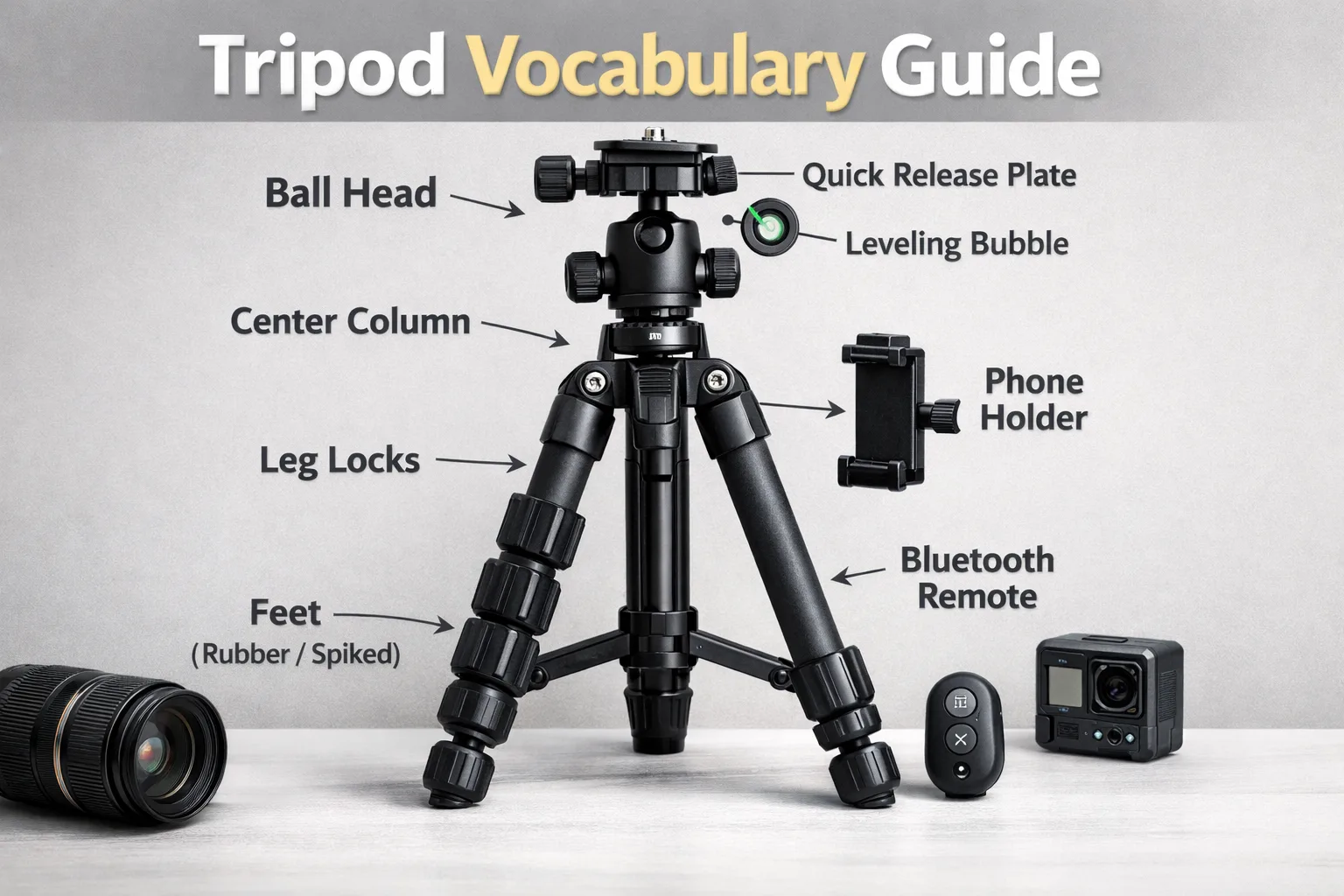
Mechanisms used to secure the legs at a specific height. Common types include flip locks and twist locks.
Center Column
The vertical pole in the middle of the tripod that allows additional height adjustment.
Feet
The bottom part of tripod legs, usually made of rubber or metal spikes for better grip on different surfaces.
Tripod Head Types
Ball Head
A flexible head that allows smooth movement in all directions—ideal for quick adjustments.
Pan Head (3-Way Head)
Allows movement in three axes (up/down, left/right, tilt). Great for photography precision.
Fluid Head
Designed for videography, it provides smooth and controlled motion.
Gimbal Head
Used for heavy cameras and telephoto lenses—commonly used in wildlife photography.
Pan-Tilt Head
Provides separate controls for horizontal and vertical movements.
Mobile Tripod Vocabulary
Phone Mount / Holder
A clamp that securely holds your smartphone in place.
Universal Clip
An adjustable holder that fits different phone sizes.
Selfie Stick Tripod
A hybrid device that works as both a selfie stick and a tripod.
Bluetooth Remote
A wireless remote that lets you capture photos without touching your phone.
Build & Material Terms
Aluminum Tripod
Affordable and durable but slightly heavier.
Carbon Fiber Tripod
Lightweight, premium, and more expensive—ideal for travel.
Load Capacity
The maximum weight the tripod can safely hold.
Build Quality
Refers to the overall durability and strength of the tripod.
Height & Portability Terms
Maximum Height
The tallest height the tripod can reach when fully extended.
Minimum Height
The lowest shooting height possible.
Folded Length
The size of the tripod when packed or folded.
Compact Tripod
Small and easy to carry.
Travel Tripod
Lightweight tripod designed for portability.
Camera & Shooting Terms
Stability
The tripod’s ability to reduce camera shake.
Leveling Bubble
A small bubble indicator that helps you keep your shots straight.
Quick Release Plate
Allows fast mounting and removal of your camera.
360° Rotation
Enables full circular movement for panoramic shots.
Tilt Angle
Defines how far the camera can tilt vertically.
Advanced / Pro Terms
Monopod Conversion
Some tripods allow one leg to detach and function as a monopod.
Spreader
A support system between legs that increases stability.
Hook (Center Hook)
A hook under the tripod to hang weight (like a bag) for extra stability.
Anti-slip Grip
Prevents the tripod from slipping on smooth surfaces.
Damping System
Ensures smooth motion—especially useful for video shooting.
Conclusion
Understanding tripod terminology isn’t just about learning technical words—it’s about making smarter buying decisions. Whether you’re a beginner शूटिंग with your smartphone or a creator using a professional camera, knowing terms like ball head, load capacity, and stability helps you choose the right tripod with confidence.
This vocabulary guide gives you a solid foundation to compare features, avoid confusion, and invest in a tripod that actually meets your needs.